Stop plastic

van Stad naar Wad

Duration: 3 years, 2021-2024  

Contact person: Arnoud van der Vaart  

Client: Rijkswaterstaat (RWS), Wadden Fund, Municipality of Groningen, GSP (Global Water Service), and Noorderzijlvest Water Board  

Location: The canals of Groningen, Eemskanaal, Reitdiep, and the Port of Delfzijl. 

Stop plastic van Stad naar Wad

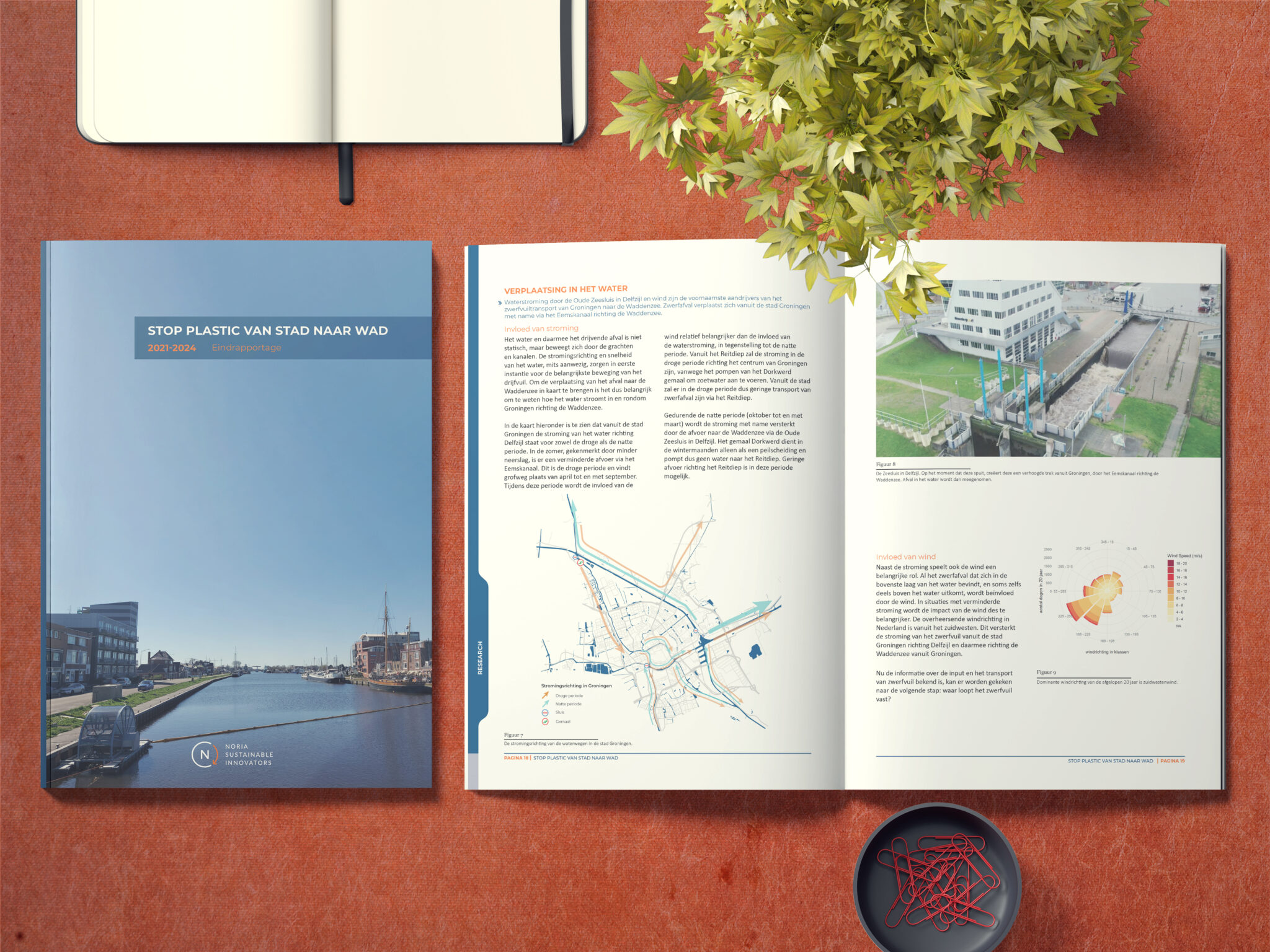
The Wadden Sea is a beautiful nature reserve of global importance and has therefore been designated a UNESCO World Heritage Site. However, our Wadden Sea is not doing well. The area is increasingly polluted by plastic waste. To tackle this problem at its source, the Wadden Fund, together with other involved organizations, commissioned Noria to map how this plastic from Groningen’s inland waters ends up in the Wadden Sea and how the waste can best be removed 

What are the benefits of this project?

In the “Stop Plastic from City to Wadden Sea” (in Dutch: Stop Plastic van Stad naar Wad”) project, Noria is researching the route plastic waste takes from the Groningen Reitdiep and Eems-Dollard rivers to the Wadden Sea. The project investigates how plastic waste can be collected in the most sustainable and fish-friendly way possible. Included in this research are the influence of factors such as wind, currents, and the type of shoreline on the spread of the plastic. Finally, the different types of found plastic are analysed. 

The “Stop Plastic from City to Wadden Sea” project generates a great deal of new practical knowledge about the route plastic waste takes. Based on this data, a preventative approach is chosen, removing the plastic as close to the source as possible. This is done effectively and sustainably. The knowledge gained from this project will be shared with water managers around the Wadden Sea to maximize the positive impact. 

Stap 1: Insight through Analysis

The first step is an analysis of the area to quickly identify potential hotspots. Hotspots are locations where plastic waste accumulates under the influence of wind, water currents, and the shape of the waterway. The research is conducted using a GIS model and algorithms developed by Noria. 

This theoretical analysis is then validated through fieldwork. In this phase, we consult with local area managers and verify the potential hotspots to determine whether there are indeed elevated concentrations of plastic waste. The strategic locations identified in this process are subsequently monitored with cameras. 

Based on the analysis and validation, an initial picture emerges of where the plastic originates and where it accumulates. In this way, the most critical areas in Groningen and along the Eemskanaal and Rietdiep have been mapped and validated. Throughout 2023, these hotspots were visited multiple times to gain deeper insight into the conditions under which they form. 

Read more about our 3Rmethodology to tackle waste plastic in water in three steps: Research, Remove and Reduce 

Stap 2: Tackling the Source

Step 2 combines both a curative and preventive approach. Based on the identified hotspots, we deploy our sustainable and fish-friendly collection systems, the CirCleaner and CanalCleaner, at various locations. These systems remove the accumulated plastic waste, forming the curative part of the approach. 

The collected plastic is then analyzed using the OSPAR methodology, the most detailed protocol for characterizing the type and composition of litter in inland waters. This analysis provides insight into which plastic products or categories are most prevalent, and thus, what the main sources of pollution are. These insights form the foundation of the preventive part of the approach: preventing plastic waste from entering the water in the first place. 

CirCleaner

The CirCleaner is a sustainable and fish-friendly collection system. It removes floating plastic waste in a simple yet effective way using five rotating scoops that move against the current. Thanks to its smart design, the CirCleaner can be installed almost anywhere, under bridges, near pumping stations, or at sluices. The system is highly flexible and can be installed or removed within a single day. 

OUR DASHBOARD PROVIDES INSIGHT INTO THE PROBLEM 

Analyseren en identificeren

Door het analyseren van verwijderde plastics uit water ontstaat inzicht waarmee het veel beter mogelijk is om zeer effectieve en gerichte lokale preventieve aanpak op te zetten. Wij merken door onze ervaring in de laatste jaren dat hét plastic afval probleem niet bestaat. Het is een enorm groot probleem, maar ook een probleem die per locatie sterk kan verschillen. Zo is het plastic afval probleem dicht bij steden erg verschillend met bijvoorbeeld het plastic afval probleem in havens. Dit vraagt om een verschillende aanpak curatief, maar zeker ook preventief. Door actief te analyseren en plastic te verwijderen (curatief) krijg je inzicht in de bron van plastic. Dat kunnen productcategorieën en producenten zijn, maar ook mogelijke consumentengroepen. Afhankelijk van dit inzicht werkt een bepaalde preventieve aanpak het meest effectief. Op deze manier kan je morgen dus al beginnen met het stoppen van de stroom plastic naar de Waddenzee en kan je zeer effectief de kraan dicht draaien voor de lange termijn. 

OSPAR analyse

Om zwerfvuil in rivieren en zeeën te voorkomen of te verminderen is inzicht nodig in de grootte van het probleem. Zwerfvuil in de wateren moet daarom gemonitord worden. Hiervoor is de internationale standaard voor plastic analyse, de OSPAR Guideline for monitoring marine litter on beaches (Beach-OSPAR), ontwikkeld. Stichting de Noordzee heeft het rivieroever afvalmonitoringsprotocol (de River-OSPAR) gebaseerd op de Beach-OSPAR. De River-OSPAR methode wordt gebruikt om data te verzamelen over zwerfafval op oevers van Nederlandse rivieren. Dit wordt gedaan door vrijwilligers (citizen science). Het River-OSPAR-protocol is het meest gedetailleerde protocol om het type en de samenstelling van het zwerfafval op de rivieroever te karakteristeren. Deze methode maakt gebruik van een gedetailleerde itemlijst met meer dan 100 specifieke items en 10 hoofdcategorieën om het gevonden afval in onder te verdelen. De meeste andere protocollen geven dergelijke gedetailleerde informatie niet, en beschrijven slechts algemene materiaal categorieën (plastic, hout, glas). 

Stap 3: Identification and Monitoring

In step 3, analysis of the collected plastics provides valuable insights that enable the development of a highly effective and targeted local prevention strategy. After all, there is no single plastic waste problem. It is a vast global issue, yet it varies greatly from location to location. For example, the plastic waste challenge near cities differs significantly from that in ports. This requires different curative and preventive approaches. 

By removing and analysing the plastic waste, we gain insight into its sources. These may include specific product categories, producers, or even consumer groups. Depending on these findings, the most effective preventive measures can be implemented. With targeted interventions at the source, we can begin reducing the flow of plastics to the Wadden Sea immediately. 

Continuous monitoring of waterways and hotspots remains essential to enable rapid response when needed. Noria has developed a practical dashboard for water managers to track, in real time, the presence of plastic waste in waterways and take action where necessary. 

Results so far

Research shows that in the waters surrounding the city of Groningen, large amounts of fast-food and beverage packaging are found. In the port of Delfzijl, the most common items are cable ties and various types of plastic film. In the Reitdiep area, plastic is found less frequently, but when it is, it often originates from agricultural sources such as fertilizer bags. 

Take a look at the project Video

Meer informatie?

Would you like to learn more about the project Stop plastic van Stad naar Wad project, or are you curious about what Noria could do for your area? 
Please send an email to: